SELECT PAGE
|
| Website structure and orientation to be changed this year. Yesilo will be writing new chronicles of hunters in the tropical rain forest in Cameroon. I'll share with you some of the most incredible hunting stories I have ever heard. |
|
My name is Edouard Betsem, MD, Clinical Pathologist. This great adventure with the very poor populations of rural Cameroon started in 2001. I was then posted as a chief medical officer somewhere in a remote area downsouth Cameroon in central Africa. A place called Oveng with nearly 5000 souls. Most o fthem are poor native villagers from different tribes and clans. My responsability as a MD was to provide all kinds of curative medical cares and enforce all preventive health strategies in the area and its populations. At the same time, I became field investigator for different research projects in the area. Build experience in studying population genetics. Then, virology more specific for emergence mechanisms in populations in contact with non human primates. This is how I came to learn a lot about the history and culture of populations living in these tropical remote areas, especially Pygmies from the Baka and Bakola tribes. These people's survival is based upon crops and hunt products. My experience of the field grew stronger, as well as my knowledge of the Pygmies culture and way of life, and my motivation to commit to do something about furthering their emancipation and the development in the area.
|
|
The most striking aspect of their existence is poverty and the state of neglect they are living in. Prone to infectious diseases and death, poorly or not educated at all, defenseless against their Bantus neighbors and up coming progress. The most ancient inhabitants of the forest, the Pygmies are a little lost in a changing world. I noticed how neglected they can be, unable to access by themselves the simpliest things modern life can offer nowadays. They are unable to access good medical care because of money, they are prone to so many infectious disease responsible of a big mortality rate. They are unable to dress properly for they cannot afford good clothings, defenseless against crushing giant steps of modernism, and slowly destroyed by alcoholism. From the southern to the eastern parts of Cameroon, i have visited dozens of villages, met thousands of people, and nowhere have i seen more humiliated and vassalized population than Pygmies.
|
| | We can either stay aside and think like many that Pygmies may not need to adopt a modern way of leaving, that may not need education as well, pretending their current way is best for them. We can think and believe that until a tarred road crosses their villages or a factory or mining be started not far from the village. We can keep interacting with them with our cameras to take their pictures when we drive past their villages, or our needles to sample their blood for reseach purposes. We can look at them dying from disease and alcoholism or we can just behave differently and provide them with sufficient education and means to make their own choices. That's the only way so they can free themselves from their long dependance towards the Bantus and face the moving world.
|
|
The actions we started in frame of professional activities are shifting into most coordinated humanitarian activities in the future. we started with providing medical counselling and first necessity drugs during surveys, and more recently, we started giving donated clothing. A progressive development program targetting a couple of pilot villages is being conceived. Great things are sometimes made out of small thoughts. Little actions with little money can go a long way and give others hope for a better tomorrow.
|
|
YESILO is from the name of a Baka Pygmy clan.
Coordonated actions in Baka Pygmy villages and settlements in south and east of Cameroon can bring out permanent solutions.
contact.yesilo@gmail.com |
|
Pygmies are time immemorial dwellers of the tropical rainforest. In Central Africa, they are found in Democratic republic of Congo, Gabon, Central African Republic, Congo, Cameroon, and other countries of western Africa like Rwanda, Burundi and Uganda. They are among the oldest inhabitants of Africa.
Pygmy tribes:
Pygmy are scattered over Africa in different tribes almost all starting by “Ba” meaning “people”.
- BaKa
- BaGyeli/BaKola
- Bedzan/Tikar
- BaMbuti
- BaTwa
- BaYaka
- BaBongo
- Aka
Their languages
The different pygmy groups express in different languages making comprehension almost impossible between them. All the pygmy tribes speak the language of neighbouring no-pygmy peoples and sometimes common words are found, probably as a result of a long cohabitation. Common words are also found between different even widely separated.
Read more about Pygmies
|
| 
Their way of life
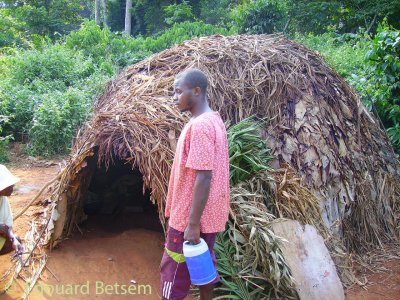
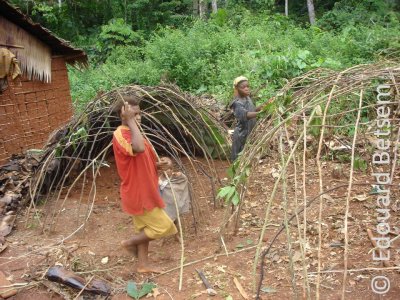
Pygmies are known to be forest dwellers that live through hunting, gathering and fishing. These activities are mostly done for survival but hunting was also practiced for the prestige of the hunter. They know the forest and its animals very intimately. They believe in the forest as a providing god and they communicate with him through its spirit, the “Jengi”. In the Pygmy culture, men are holders of the traditions and initiation secrets. They hunt to provide wild game. Women are responsible of building the leaves huts called “Mongulu”, they do dam fishing during dry season, they do the cooking, making panniers, baskets, matting and since more recent times they do the farming together with their husbands.
Pygmies have a polyphonic music involving everybody and instruments like drums, flutes, bells and thumb pianos. There are different types of dances for almost all occasions and some on very specific occasions like initiation or funerals involving initiated dancers.
Pygmies live close to the Bantu villagers, neighboring their habitat. This symbiotic cohabitation is known for times immemorial and involves exchange of forest products for other goods and crops. These exchanges are most of the time unfair and give advantage to the villagers who claim their superiority to the Pygmies.
Pygmies have been encouraged by the government of Cameroon to leave the inner parts of the forest and settle in villages alongside roads just like farming Bantu villagers. This process has been gradually taking place over years and Pygmy villages and settlements are now found alongside roads almost everywhere in the Center, Southern and Eastern areas of Cameroon. Pygmies are now given identity cards and birth certificates; they vote and get gradually adapted to civilized life. Bantu villagers rent them nearby lands for farming, and they have learned how to build houses instead of their traditional dome shaped leaves hut called “mongulu”. These traditionally nomad forest people now progressively dream of something else than the forest. Most of them wish to send their children to school, dream of success and celebrity just like their TV stars, most of them are involved in local activities, including politics, religion and development projects. Despite the “call of the forest”, Pygmies are now irreversibly moving into a new way of life and new practices.
|
| What problems they face
The land:
Pygmies now in Cameroon are adopting a sedentary way of life because of different factors on the lands Bantu villagers were first to occupy alongside roads. Since there are scattered almost everywhere in the forest, there is no real Pygmy land recongnized to them by villagers or government. Thata situation is being maintained by the inferiority complex that almost all the Pygmies developed throughout the years of cohabitation with Bantus and their quickness to move whenever a problem occurs. The first action ever made in that direction was recently started by catholic missionaries in Le Bosquet near Lomié, East Cameroon.
Deforestation:
Continuous deforestation and plantations are cutting into the forest, reducing hunting territories and natural resources that are essential for Pygmies biologic and cultural survival. This increases dependence towards the Bantus.

Health:
Poor hygiene malnourishment and numerous infectious diseases like Tuberculosis and other lungs infections, malaria, viral infections are responsible of an important mortality rate. We estimate that 20 to 25% of the population is ill, especially children. They cannot access adequate health care since their resources are very limited.
Education:
Access to high school and college is almost impossible since they cannot afford it without sponsors. That is one reason among many why they stop going to school, which is very dramatic for this people. In a world in which education and money for almost all needs are key words for a better living, this adopted sedentary way of life has exposed these unprepared people to a rude rapidly changing world. The process seems to have reached a disadvantaging dead end point. Getting out of it requires full continuous social, educational and technical assistance until an appropriate and satisfying individual and collective adaptation capacity is attained, in some areas.
Pygmies way of life has been deeply disturbed during the recent decades. Since this process seems irreversible, assistance for a better and efficient adaptation is necessary to avoid seeing them being crushed by our changing world.
Pygmies are unique and they need your support. We are trying to do as much as we can. So many things can be done with little money. |
|
 Cameroon is located in Central Africa and faces the Atlantic Ocean by the gulf of Guinea. Cameroon is located in Central Africa and faces the Atlantic Ocean by the gulf of Guinea.
The country is organized into ten regions (provinces): Far North, North, Adamaoua, North West, West, South West, Littoral, Centre, South, East.
The country population is divided into more than 234 ethnic groups.
Read more about Cameroon or Visit Cameroon
We conduct our activities in these areas:
Center:
- Various Bantu populations, mostly, Ewondo, Eton, Bafia, Banen
- One Pygmy tribe, the Bedzan-Tikar
South:
- Various Bantu populations, mostly Bulus, Fang, Ngumba, Batanga
- Two Pygmy ethnic groups, the Bakas and the Bagyeli-Bakola
East:
- Various Bantu populations, mostly Maka, Badjoue, Bikele, Zime
- One Pygmy ethny, the Bakas |
|

A pygmy settlement in Yen near Djoum (2001)
In this remote settlement, we found few families living in huts. children were malnurished and bearing intestinal parasites. A young 15 year old girl was almost dying of malaria.
We provided the families with strong advices about hygiene both individual and collective.
We gave all the children antiparasitic drugs for systematic deworming, as well as antimalaric drugs for the young girl and the whole family. Few weeks later the girl was fine and could do her daily falily farming activities. |
| 
Denis and I with a Pygmy family in Yen near Djoum (2001)
In this house, we found a pregnant woman with malaria and her two malnurished children.
Children were systematically dewormed and the woman treated for malaria, anaemia and worms.
Few weeks later, The woman had delivered inside the house as usual and the baby was fine though, wrapped inside old clothes and fed with what was left in her mother's breast. we gave them clothes and a bottle of milk for a few days... all we could do then |
| 
Pygmy children in Mebane Near Djoum (2002)
Children in all villages we visit are alwys systematically deworwed as interstinal polyparasitism is very common and responsible of malnurishment, asthenia loss of attention in school, and sometimes major trouble like gut occlusions in case of massive invasion by adult worms (Ascaris lumbicoïdes). with little we can have very good results. But Hygiene remains a major challenge.
|
| 
Medical counselling in Minko'o Near Djoum (2002)
Usual meating gathering all the village people, especially woman and children for medical counselling in a very motivated question/answer interaction. After these talks people areprovided with primary medical cares and drugs.
|
|

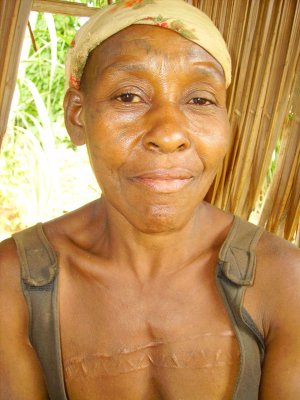
A Pygmy hunter in Zoebefam near Mintom (2003)
We found this Pygmy hunter in his village and brought him into the hospital i was running at that time. I performed on him an operation for a right inguinal hernia and his wife received few kitchen tools. |
| 
Medical cares in a school near Mintom (2003)
|
| 
Talks in a village near Djoum (2003)
|
| 
Petit Jean on the road to Mintom (2003)
Very difficult and improbable bush tracks. Fallen trees can it very difficult to drive. But we like the adventure side of the Job.
|
|

FIRST NECESSITY DRUGS
|
| 
SYSTEMATIC DEWORMING |
| 
GIVING DRUGS AND COUNSELLING TO A BAKA WOMAN |
|
These places are located in the Eastern part of Cameroon. The area is populated by Baka Pygmies and different Bantu ethnic groups including Badjoue, Bikele, Zime, Mpoubiem, Maka and others.
|
|

BIFOLONE: DJA RESERV |
| | We gave clothing, first necessity drugs and medical counselling as usual for hygiene and prevention of infectious diseases. |
| 
MBOUMO BEA |
|

DIMPAM |
| 
NDJIBOT |
|

DJENOU |
| | 
DJENOU |
|

DJENOU FAMILLY |
| 
DJENOU |
|
Volunteer for missions in the villages
|
|
Sponsor a Pygmy child for school
|
| |
Pay for specific health care
|
|
Books and educational materials
|
|
Help pay field supervisor, primary school teacher.
|
|
Pygmies are unique and they need support. Whatever help you can provide is welcomed with great joy and a smile..
HELP THEM.
|
|
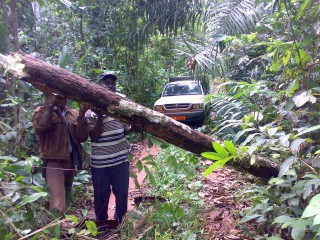
CUTTING TREES ON THE ROADS
Very common after windy rains. |
| 
NYONG RIVER, AYOS
Beautyful river and swamps. Natural border between Center and East regions. |
| 
ELEPHANT JUST PASSED HERE
We saw the last one vanish into the forest. |
|

CATERPILLARS
Very appreciated menu in the area. |
| 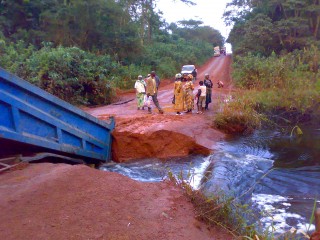
COLLAPSED BUZZARD
Under the weight of a heavy truck. we stopped here and had to drive back and make a 60 km detour. |
| 
COMMUNITY DISPENSARY
In so many villages this is how the health house looks like. Old, empty and abandonned. |
|

TRUCK IN HOUSE
Somewhere around Akonolinga.
|
| 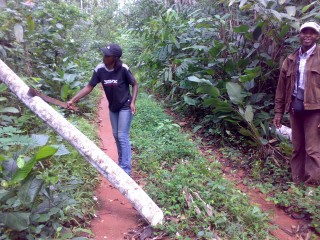
EVERYONE WORKS WHEN IT'S NECESSARY
Frederique here came to rescue |
| 
LUNCH TIME
Roger the driver drinking red wine in a sardines can. You'd better not do this!! |
|
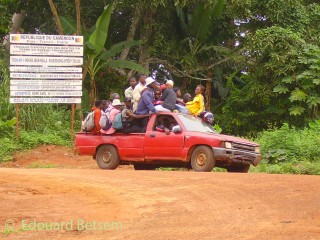
A BUSH TAXI NEAR AKONOLINGA: SOUTH CENTER CAMEROON |
| 
TIME FOR SHOPPING |
| 
ROAD BLOCK
|
|
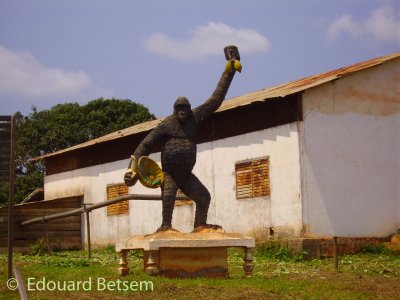
BENGBIS, SOUTH CAMEROON |
| 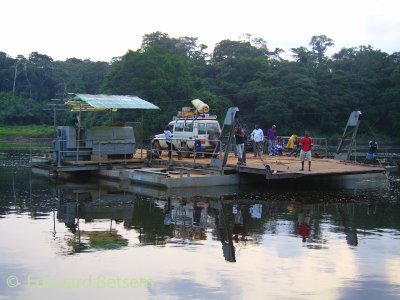
RIVER DJA: NGOÏLA ROAD, EAST CAMEROON |
| 
POST OFFICE IN LOMIE: EAST CAMEROON |
|
Edouard BETSEM is MD by training, graduated from the Faculty of Medicine and Biomedical Sciences at the University of Yaounde 1/Cameroon. He completed a specialist training as a a Clinical Pathologist in the same school of Medicine before having his PhD in Virology from the University of Paris 7 / Denis Diderot and the Institut Pasteur de Paris. His most recent degree was a Master of Public Health from the CNAM/Pasteur school of public health in Paris.
Edouard, is a full passionate of field epidemiology, and the thematic of circulation of viruses in natural settings, disease emergence through cross species transmissions from animal reservoirs to humans, especially in Central Africa where he conducted numerous field works on the early steps mechanisms at the origin of an emergence in humans of retroviruses such as Simian foamy viruses.
He is a full time sport and martial arts practitioner. He has created the Kaeten Jutsu Initiative in Cameroon and the Universal Self Defense association in Bangui/CAR for full martial styles practitioners. He is a Jazz and Blues lover, singer and song writer in his spare times.
He has been conducting in South, East and Central Cameroon, field works on the genetic of the forest populations in Cameroon, and some high impact molecular epidemiology works on Simian foamy viruses and Human Herpes virus 8. These field works have contributed to an comprehensive update of the epidemiology of HTLV 1/2/3 viruses in Central Africa and the description of a new strain of newly discovered HTLV3.
Dr Betsem is also a devoted humanitarian who was attracted to one day to the life of Baka Pygmies in Cameroon. The Yesilo initiative is one way he found to participate to the full emancipation of that Pygmy tribe. He is sponsoring two Baka school children every year and frequently offers counselling, drugs, clothing and medical assistance including surgery, with the generosity of team members, colleagues, friends, family and different associations.
Dr Edouard BETSEM is also involved in different national and international professional organisations orking on improving population health, science and living standards in Cameroon, Africa and elsewhere. |
|
edouard.betsem@medcamer.org
|
|
AUGUST 2014
Next trip in Bakas area
We are accepting donations.
|
|
COPYRIGHT NOTICE
This website blog has been created by Dr Edouard Betsem, MD, PhD, MPH, as a result of his interest for the Pygmies living in Cameroon and with the contribution of various people from France, Cameroon and especially the Baka, Bakola and Bagyeli Pygmy tribes.
All texts, photos, audio and video recordings in this site are by the author, and come from his field trips for reseach anf humanitarian purposes in the Center, South and East regions of Cameroon.
Copyright © 2001-2009 Edouard Betsem A Betsem.
All rights reserved. Reproduction of texts, images, videos, music and sounds, as well as print and elaboration of the content of the site, is forbitten, also for not-profit use.
To buy the publication rights for photos, videos or music recordings contact the author.
The aim of these pages is to provide information about the author's work on the field and his interest for the Baka Pygmies as well raising concern of all on their life, culture and problems. This site is dynamic as actions keep going continually on the field providing with more documents and comments available as they are collected. some of the collected ones are stillunpublished on the site and will soon be.
More information will progressively be communicated on the website blog. |
|

JOY ASHLING and her movement CHILDREN's AID IN ACTION
|
| |
| Joy Ashling is very dedicated to the causes of poor children and Pygmies in Cameroon. She created an associative movement called "CHILDREN'S AID IN ACTION" and privides considerable material and warm-hearted help to handicaped children and orphans in Cameroon. She collected and donated CLOTHING and SCHOOL MATERIAL for Pygmies.
Thank you for your concern |
| SARA CALATTINI, her family and friends at The Institut Pasteur in Paris.
for collecting and donating money for a surgical operation on a 3 year old girl. That operation helped that little girl recover functionality of her legs. She can walk and run now.
Thanks Sara |
|
These people in The University Teaching Hospital in Yaounde>
Pr Marie-Thérèse OBAMA (Pediatrician)
Pr TAKONGMO (Surgeon)
Pr Maurice NKAM (Reanimator, Director of the UTH Yaounde)
The Ministry of Social Affairs>
|
| Pr Antoine GESSAIN (Intitut Pasteur Paris)
Dr Alain Froment (IRD)
Dr François RIVIERE (IRD)
Petit Jean |
|
|



.jpg)